An unsolicited email promising your practice “page one on Google” is almost always spam. Google’s own guidance for site owners says “No one can guarantee a #1 ranking on Google”, and the offers that do guarantee page one usually mean page one for phrases nobody searches. Delete the email, mark it as spam, and don’t reply.
This guide shows three real examples with notes on what gives each one away, the checks worth a minute of your time, what UK law says about who may email your practice, and what to do if you have already signed. A disclosure first: Cogrank sells SEO and Google Ads to UK private dental practices. Cogrank does not send unsolicited emails to practices and does not guarantee rankings.
Written by Bogdan Matanie, founder of Cogrank, with 12+ years in technical SEO and paid search, working exclusively with UK private dental clinics. Last updated October 2026.
Why does my dental practice get so many SEO emails?
Because the practice’s address is public, sending is almost free, and a dental client is worth a great deal to an agency.
Your email address and contact form sit on your website and your Google Business Profile, where scraping tools collect them by the thousand. Agencies will pay more than $100 for a single Google Ads click from someone searching “dental seo agency” in the UK (Google Ads estimate, October 2026), so a mass email that lands one practice in a few thousand still pays.
In Cogrank’s experience, most of these pitches arrive through the website contact form and the info@ inbox. Phone calls about the practice’s “Google listing” are common too. In 2026 a new variant started arriving: the same pitch, now promising to make the practice appear in ChatGPT and other AI search tools.
Can anyone guarantee page one on Google?
No. Google’s page for site owners considering an SEO, Do you need an SEO?, states that “No one can guarantee a #1 ranking on Google” and warns owners to “Be wary of SEO firms and web consultants or agencies that email you out of the blue.”
The offers that guarantee page one get around this by choosing the phrases. Bogdan Matanie’s view from audits: a page-one guarantee never covers the high-traffic, high-difficulty searches a practice cares about. It covers long-tail phrases with zero monthly searches.
Cogrank’s own Search Console shows what such a ranking is worth:
| Search phrase | UK searches a month (Google Ads estimate) | Cogrank’s average position, 13 Jul – 15 Oct 2026 | Clicks |
|---|---|---|---|
| how to get more private dental patients | No measurable volume | 7.3 (position 1 most days since 2 October) | 0 |
| google ads for dentists | 90 | 75.4 | 0 |
| dental seo | 480 | 87.1 | 0 |
The first row is what a guarantee buys: a top ranking, about one impression a day and no clicks. It would look impressive as a screenshot in a monthly report. The last row is the search that matters, and climbing it takes months of content and earned links, which is why nobody can promise it. Realistic timelines are set out in Cogrank’s guide to how long dental SEO takes and what it costs.
Bogdan’s advice for the first 30 seconds of any conversation with someone offering a guarantee:
“Ask them how they can guarantee a ranking when Google’s algorithm is secret and the results page keeps changing: competitors improve, Google rolls out spam and core updates, AI Overviews appear, and search ads sit on top.”
What do SEO spam emails to dental practices look like?
Short, flattering and vague. Here are three real emails that reached Cogrank, with the senders’ names and contact details removed.
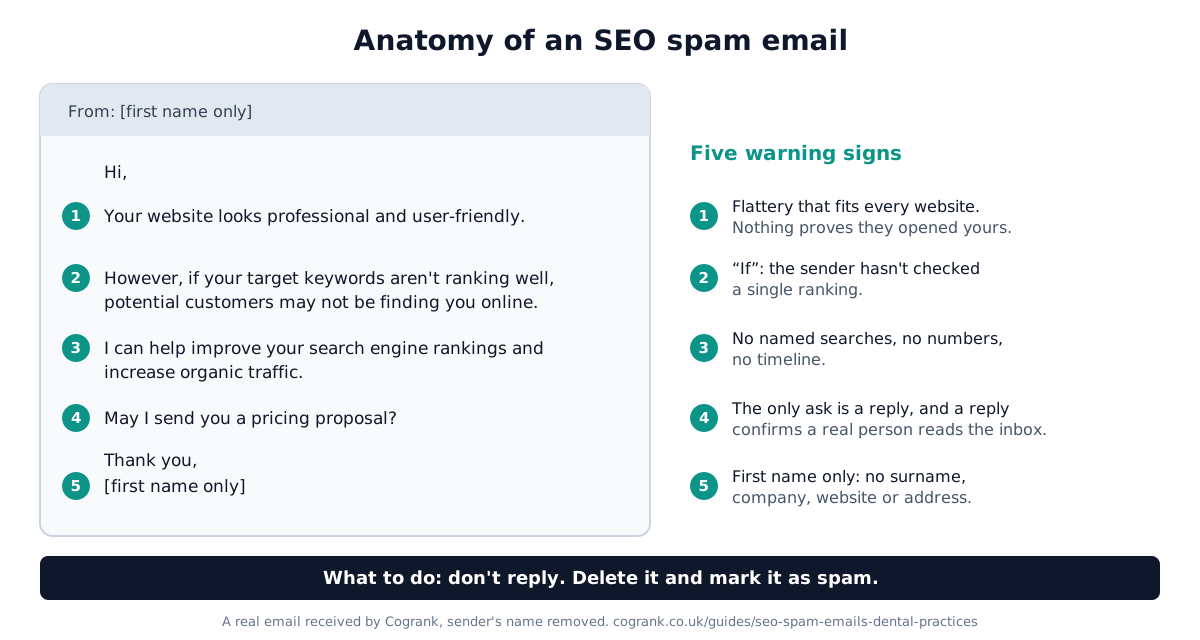
Email 1: the opener
Hi,
Your website looks professional and user-friendly. However, if your target keywords aren’t ranking well, potential customers may not be finding you online.
I can help improve your search engine rankings and increase organic traffic.
May I send you a pricing proposal?
Thank you, [first name only]
- “Your website looks professional” contains nothing that proves anyone opened the site. The same sentence fits every website on the internet.
- “If your target keywords aren’t ranking well” is a conditional. The sender has not checked a single ranking.
- There is no surname, company, website or address.
- The only request is a reply, and a reply tells the sender that a real person reads the inbox.
Email 2: the chaser
Hi, Just checking in. If you want to work toward better search positions, I’d be glad to discuss your website. Let me know if I should send the information. Thanks,
This one has no name at all. Cold-email software sends follow-ups like this automatically when the first message gets no answer, so silence does not stop them. The spam filter does.
Email 3: the link seller
Hi Bogdan,
We’ve been doing link building for 10+ years, we know the ropes.
We place 5,000+ links a month from a database of 50,000+ sites, sorted by country. Strong Spain coverage.
Trusted by 1000+ clients. No smoke and mirrors, just good sites at a price that makes sense.
Would you like see a few examples for Spain?
[name], Head of Marketing [US phone number] [street address in Sheridan, Wyoming]
- The first name is a mail-merge field. Nothing else in the email is specific to the recipient.
- “5,000+ links a month” from a database of sites describes a link-selling operation. Google’s spam policies list “Buying or selling links for ranking purposes” as link spam. Paid links are allowed only when labelled as paid (
rel="sponsored"orrel="nofollow"), and a seller promising ranking gains is not selling labelled links. - The street address is a building in Sheridan, Wyoming that The Sheridan Press reported in March 2026 houses 26 commercial registered agents, representing close to 300,000 companies. An address shared by that many companies tells you nothing about who you would be paying.
The pattern holds across the variants a practice is likely to see:
| What arrives | What it is really selling | What to do |
|---|---|---|
| “Page one” or “improve your rankings” email | Rankings for phrases with no searches, shown in a PDF | Delete and mark as spam |
| “Just checking in” chaser | The next step of an automated sequence | Ignore and mark as spam |
| Link-building offer | Paid links that breach Google’s spam policies | Never buy; links like these can later need cleaning up |
| Call or email “from Google” about your Business Profile | A fee for something Google provides free | Hang up and report it to Google (form below) |
| “Rank you in ChatGPT and AI search” | The same guarantee under a new label | Ask which questions, in which assistant, and how they would measure it |
Google states that it “will never try to convince you to pay to maintain your Business Profile” (Google Business Profile Help) and will never “guarantee you a special spot” in its products (Google’s guidance on misleading calls).
What should you check before replying to a marketing email?
Five things, and an email that fails the first two is not worth the other three.
- Specifics. Does it mention something only a person who looked would know: a treatment page, a ranking, a broken booking link? Flattery doesn’t count.
- A real company. Look for a full name, a website on the company’s own domain and, for a UK firm, a company number you can check free on Companies House. A Gmail address or a registered-agent address is not a company.
- Which searches, and how many people make them. Ask for the exact phrases they would target and the monthly search volume of each. A list of phrases with no volume is the guarantee trick.
- The guarantee question. Ask how they can guarantee a ranking that Google says nobody can guarantee. A credible agency answers with a plan and a timeline.
- Ownership. The Business Profile, the Google Ads account, the domain and the website should be in the practice’s name from day one, with the agency added as a user.
If a proposal survives all five, compare it on price and scope with the five-question checklist in Cogrank’s dental SEO pricing guide.
Is it legal to send a dental practice unsolicited marketing emails?
It depends on how the practice is set up. Under the Privacy and Electronic Communications Regulations (PECR), a sole trader or an ordinary partnership in England, Wales or Northern Ireland must have consented before anyone sends it marketing emails. A limited company, an LLP or a Scottish partnership can be emailed without consent, as long as the sender identifies itself and gives a working opt-out address.
| How the practice is set up | PECR treats it as | Marketing emails allowed without consent? |
|---|---|---|
| Sole trader (principal dentist trading in their own name) | Individual subscriber | No |
| Partnership in England, Wales or Northern Ireland (not an LLP) | Individual subscriber | No |
| Limited company or LLP | Corporate subscriber | Yes, if the sender identifies itself and offers an opt-out |
| Partnership in Scotland | Corporate subscriber | Yes, on the same conditions |
Sources: the ICO’s PECR key concepts and business-to-business marketing guidance. PECR’s “soft opt-in” exception covers only people who bought from, or negotiated with, the sender, so it does not cover a cold pitch.
Every sender, whatever the practice’s legal form, must not disguise or conceal its identity and must give a valid address for opt-out requests (PECR regulation 23). Since 5 February 2026 the ICO can fine up to £17.5 million or 4% of global turnover for PECR breaches (ICO statement). Misleading claims in marketing emails to businesses also fall under the CAP Code, whose rule 3.1 says marketing “must not materially mislead”.
| What you received | Where to report it |
|---|---|
| Unwanted marketing email | The ICO’s spam email reporting tool |
| An email that looks like a scam or phishing | The NCSC, by forwarding it to report@phishing.gov.uk (NCSC guidance) |
| A call or email claiming to be from Google about your Business Profile | Google’s third-party complaint form |
Set expectations realistically. The ICO says it does not respond to complaints individually (ICO guidance on spam emails), and senders outside the UK are hard to reach. Report UK senders anyway; for the rest, the spam filter is the practical fix.
What should you do if your practice has already signed up?
Take back control of every account first, then give notice under the contract. There is no 14-day cooling-off period to fall back on: the Consumer Contracts Regulations 2013 protect consumers, and a dentist signing for the practice is acting for the business.
- Google Business Profile. Check who the primary owner is. If the agency holds it and won’t hand it over, request ownership through Google: the current owner has 3 days to respond, after which you may be able to claim the profile, although Google says that option isn’t always available.
- Google Ads. The practice should be an admin on the account, with billing in the practice’s name.
- Domain and website. The domain should be registered to the practice, and the practice should hold the logins for the registrar and the hosting.
- Search Console. Add the practice as an owner and look at the Links report for domains that have nothing to do with dentistry or your area.
- Notice. Give written notice exactly as the contract’s termination clause requires, and keep a copy.
Bogdan Matanie’s clean-up work after this kind of agency has included disavowing spammy backlinks through Search Console and dealing with fake DMCA copyright complaints filed to get pages removed from Google’s results.
Neither is a first resort. Google says “most sites will not need to use” the disavow tool. It is meant for a site with a considerable number of spammy, artificial or low-quality links that have caused, or will likely cause, a manual action. A “toxic links” score from an SEO tool is not one of Google’s conditions. The tool also works only with URL-prefix Search Console properties, not Domain properties. If a page disappears from Google after a copyright complaint you believe is false, the site’s administrator can file a counter notification through Google’s legal troubleshooter. Google says it “may” reinstate the page, and suggests taking legal advice if you’re unsure.
Next step
If an email or proposal is sitting in your inbox and you’re unsure about it, request Cogrank’s free dental marketing audit and paste it into the message box. The audit covers local visibility, website conversion and Google Ads where applicable, and includes a plain answer on what the offer would deliver. You receive a written summary of three to five priorities. We confirm scope and timing after your enquiry; a discussion is optional. Cogrank’s terms are published: rolling monthly with 30 days’ written notice, and the practice owns every account, as set out on how Cogrank works and the dental SEO services page.